From Backend Systems to Agentic AI: Building Self-Improving Agents with LangGraph
I spent six years building backends — Laravel APIs, Node services, queues, Redis, the infrastructure that keeps systems running under load. Agentic AI pulled me in because the hard parts aren’t the model calls. They’re the orchestration. State, retries, routing, failure handling. Problems I already solve every day, now applied to systems that reason instead of just respond.
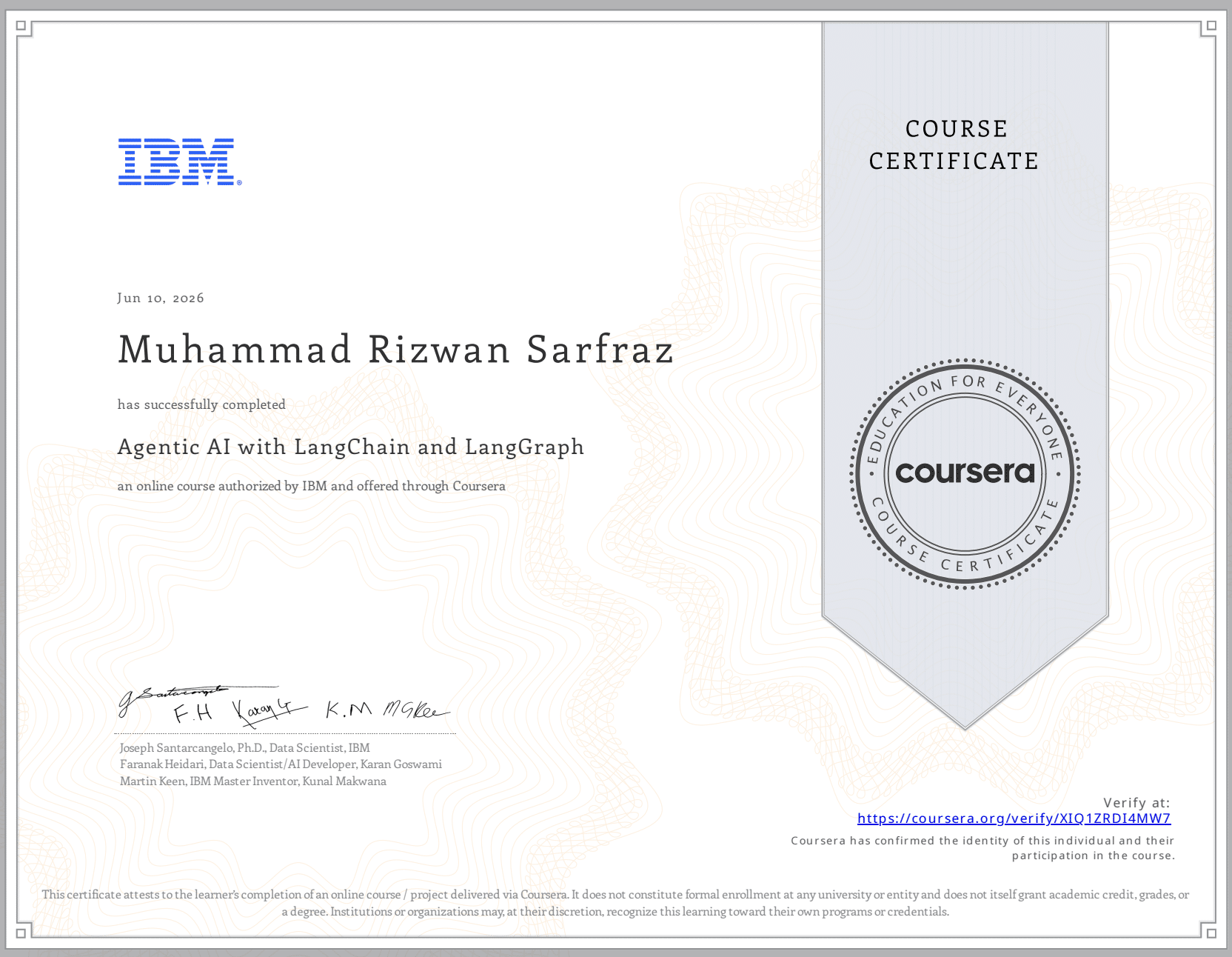
So I took IBM’s Agentic AI with LangChain and LangGraph to get the patterns straight. Here’s what I built and what stuck.
Why this course, not a YouTube playlist
Most agentic AI content stops at “call the LLM in a loop.” That falls apart the moment an agent needs memory, conditional branching, or a way to recover from its own bad output. I wanted the architecture, not the demo. This course is lab-heavy — three weeks of building working prototypes rather than watching slides.
What I built
Stateful workflows in LangGraph. The core mental model: nodes do work, edges decide what happens next, and shared state carries context across the graph. This is closer to a state machine than a prompt chain. Coming from backend work, it clicked fast — it’s the same thinking behind a well-structured job pipeline, just with an LLM at some of the nodes.
Self-improving agents. I implemented three patterns that let an agent evaluate and fix its own output:
- Reflection — the agent critiques its draft, then revises. Cheap, effective for quality bumps.
- Reflexion — adds external knowledge and structured feedback to the loop, so the agent learns from grounded signals rather than its own guesses.
- ReAct — interleaves reasoning and tool use, so the agent thinks, acts, observes, and repeats before committing to an answer.
A multi-agent RAG system. The capstone lab: specialized agents that coordinate to answer queries, with a router that sends each query to the right data source. This is where retrieval stops being a single vector lookup and becomes a coordination problem between agents.
The technical takeaways that matter
A few things reframed how I think about this work:
Agentic AI is system design, not prompt engineering. Prompt engineering tunes one response. Agentic systems manage state over time, evaluate their own output, and coordinate across components. The skills transfer directly from backend architecture — orchestration, idempotency, graceful failure.
Structured tool calls need real schemas. Using Pydantic and JSON serialization to structure what an agent passes to a tool is the difference between a reliable system and one that breaks on malformed output. Same discipline as validating an API request body.
Autonomy needs governance. More agent freedom means more failure surface. Knowing where to put guardrails, when to route to a human, and how to bound an agent’s actions is part of the design, not an afterthought.
Where I’m applying this
I already build production systems for clients across Europe — coaching platforms, a Swiss cooperative’s operations stack, multi-asset trading tools. The natural next step is agentic features inside those systems: an operations agent that handles routine cooperative workflows, a research agent that grounds answers in a client’s own documents.
What’s next
I’m continuing into multi-framework orchestration — LangGraph alongside CrewAI and AutoGen — and closing my RAG knowledge gap with deeper retrieval work. If you’re building agentic features into a real product and want someone who treats them as engineering rather than experiments, get in touch.